
Introduction
Percentage is one of the most important concepts in elementary mathematics and quantitative aptitude. We use percentages in everyday situations such as exam results, discounts, salary increases, price changes, bank interest, profit and loss, population growth, statistics, and data interpretation.
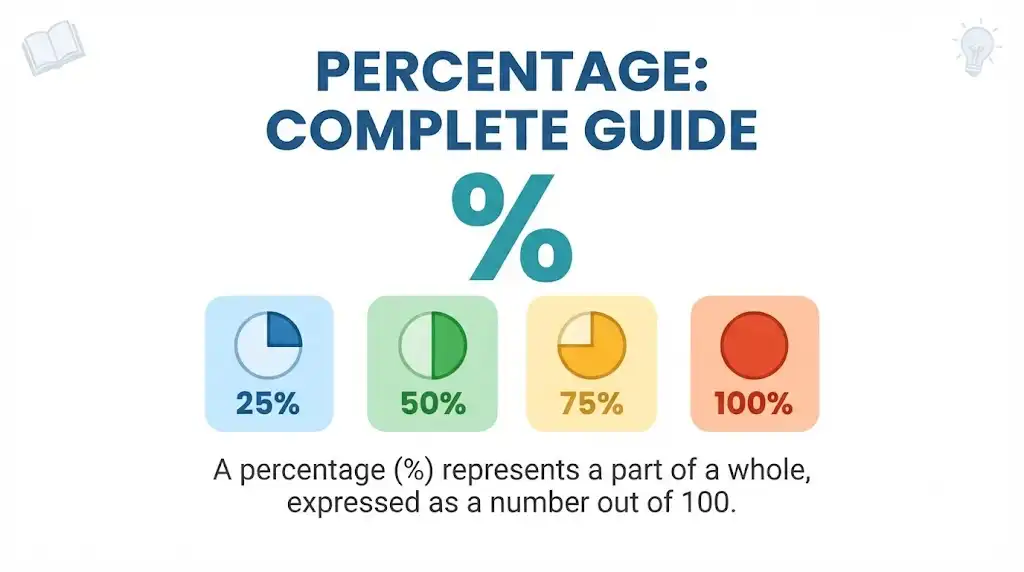
The word percentage comes from the idea of “per hundred.” Therefore, a percentage tells us how much of something exists out of 100.
For example:
- 25% means 25 out of 100.
- 50% means 50 out of 100.
- 75% means 75 out of 100.
- 100% means the complete amount.
Understanding percentages is more useful than memorizing a long list of formulas. Once you understand what the percentage represents and what number it is being compared with, most percentage problems become much easier.
This guide explains percentages from the basics and gradually moves toward percentage increase, decrease, successive changes, profit and loss, discounts, examination marks, and competitive-exam problems.
What Is a Percentage?
A percentage represents a quantity per 100.
The symbol used for percentage is %.
For example:
40% = 40/100 = 0.40
Similarly:
65% = 65/100 = 0.65
And:
125% = 125/100 = 1.25
Notice that a percentage does not have to be less than 100. A value can be greater than 100% when it is greater than the reference amount.
For example, if a company’s production increases from 100 units to 150 units, the new production is 150% of the original production.
Basic Percentage Formula
The most important percentage formula is:
Percentage = (Part ÷ Whole) × 100
Example
Suppose a student scores 72 marks out of 90.
Here:
- Part = 72
- Whole = 90
Therefore:
Percentage = (72 ÷ 90) × 100
= 0.8 × 100
= 80%
So, the student’s percentage is 80%.
Remember
In most percentage questions, correctly identifying the part and the whole is more important than memorizing the formula.
Converting Fractions Into Percentages
To convert a fraction into a percentage, multiply it by 100.
Formula
Percentage = Fraction × 100
Example 1
Convert 3/5 into a percentage.
3/5 × 100 = 60%
Therefore:
3/5 = 60%
Example 2
Convert 7/8 into a percentage.
7/8 × 100 = 87.5%
Therefore:
7/8 = 87.5%
Useful Fraction-Percentage Values
Some fractions are worth remembering because they frequently appear in aptitude questions.
| Fraction | Percentage | Decimal % | Fraction | Percentage | Decimal % |
|---|---|---|---|---|---|
| 1 | 100% | 100% | 1/16 | 6 1/4% | 6.25% |
| 1/2 | 50% | 50% | 1/17 | 5 15/17% | 5.88% |
| 1/3 | 33 1/3% | 33.33% | 1/18 | 5 5/9% | 5.55% |
| 1/4 | 25% | 25% | 1/19 | 5 5/19% | 5.26% |
| 1/5 | 20% | 20% | 1/20 | 5% | 5% |
| 1/6 | 16 2/3% | 16.67% | 1/21 | 4 16/21% | 4.76% |
| 1/7 | 14 2/7% | 14.28% | 1/22 | 4 4/11% | 4.54% |
| 1/8 | 12 1/2% | 12.5% | 1/23 | 4 8/23% | 4.34% |
| 1/9 | 11 1/9% | 11.11% | 1/24 | 4 1/6% | 4.16% |
| 1/10 | 10% | 10% | 1/25 | 4% | 4% |
| 1/11 | 9 1/11% | 9.09% | 1/30 | 3 1/3% | 3.33% |
| 1/12 | 8 1/3% | 8.33% | 1/40 | 2 1/2% | 2.5% |
| 1/13 | 7 9/13% | 7.69% | 1/50 | 2% | 2% |
| 1/14 | 7 1/7% | 7.14% | 1/60 | 1 2/3% | 1.67% |
| 1/15 | 6 2/3% | 6.66% | 1/70 | 1 3/7% | 1.43% |
These conversions can save time during competitive examinations.
Converting Decimals Into Percentages
To convert a decimal into a percentage, multiply it by 100 and add the percentage symbol.
Example 1
Convert 0.45 into a percentage.
0.45 × 100 = 45%
Therefore:
0.45 = 45%
Example 2
Convert 0.875 into a percentage.
0.875 × 100 = 87.5%
Therefore:
0.875 = 87.5%
Converting Percentages Into Decimals
To convert a percentage into a decimal, divide it by 100.
Examples
25% = 25 ÷ 100 = 0.25
60% = 60 ÷ 100 = 0.60
7.5% = 7.5 ÷ 100 = 0.075
This conversion is particularly useful when solving percentage increase and decrease problems.
Finding a Percentage of a Number
One of the most common percentage problems is finding a particular percentage of a number.
Formula
x% of y = (x/100) × y
Example 1
Find 20% of 450.
20% of 450 = (20/100) × 450
= 90
Therefore, 20% of 450 is 90.
Example 2
Find 35% of 800.
35% of 800 = (35/100) × 800
= 280
Therefore, the answer is 280.
Finding the Original Number
Sometimes the percentage and resulting value are given, and we need to find the original number.
Formula
Original Number = Given Value ÷ (Percentage/100)
Example
Suppose 30% of a number is 150. Find the number.
We know:
30% of Number = 150
Therefore:
Number = 150 ÷ (30/100)
= 150 ÷ 0.30
= 500
Therefore, the original number is 500.
Quick Check
30% of 500:
500 × 30/100 = 150
So the answer is correct.
Finding What Percentage One Number Is of Another
Suppose you want to know what percentage 40 is of 160.
Use:
Percentage = (Part ÷ Whole) × 100
Therefore:
(40 ÷ 160) × 100
= 25%
So, 40 is 25% of 160.
Important Point
The denominator represents the reference or whole amount.
Changing the denominator can completely change the answer.
For example:
40 is 25% of 160, but 160 is 400% of 40.
This is why identifying the reference quantity is essential.
Percentage Increase
When a quantity becomes larger, we calculate the percentage increase.
Formula
Percentage Increase = [(New Value − Original Value) ÷ Original Value] × 100
Example
The price of a book increases from ₹400 to ₹500.
Increase:
₹500 − ₹400 = ₹100
Percentage increase:
(100 ÷ 400) × 100 = 25%
Therefore, the price increased by 25%.
Why do we divide by the original value?
Because the question asks how large the increase is compared with the starting value.
That original value is our reference point.
Percentage Decrease
When a quantity becomes smaller, we calculate the percentage decrease.
Formula
Percentage Decrease = [(Original Value − New Value) ÷ Original Value] × 100
Example
A product’s price decreases from ₹800 to ₹600.
Decrease:
₹800 − ₹600 = ₹200
Percentage decrease:
(200 ÷ 800) × 100 = 25%
Therefore, the price decreased by 25%.
Percentage Increase and the New Value
Suppose a number increases by 20%.
The new value can be found by multiplying the original value by:
1 + 20/100 = 1.20
Therefore:
New Value = Original Value × 1.20
Example
A salary of ₹30,000 increases by 20%.
New salary:
₹30,000 × 1.20 = ₹36,000
Therefore, the new salary is ₹36,000.
Percentage Decrease and the New Value
If a quantity decreases by 20%, the remaining amount is:
100% − 20% = 80%
Therefore:
New Value = Original Value × 0.80
Example
A product costs ₹2,000 and its price decreases by 20%.
New price:
₹2,000 × 0.80 = ₹1,600
Therefore, the new price is ₹1,600.
Successive Percentage Changes
Successive percentage changes occur when a quantity changes more than once.
For example, a price might:
- Increase by 10%, and then
- Increase by another 20%.
You should not simply add the percentages and assume the final increase is always 30%.
The second percentage is applied to the already changed value.
Example
Suppose the original price is ₹1,000.
After a 10% increase:
₹1,000 × 1.10 = ₹1,100
Then the price increases by 20%:
₹1,100 × 1.20 = ₹1,320
The final price is ₹1,320.
The total increase is:
₹1,320 − ₹1,000 = ₹320
Therefore:
Total percentage increase = 32%
So, successive increases of 10% and 20% produce a total increase of 32%, not 30%.
Successive Increase and Decrease
This is an especially important concept for aptitude examinations.
Suppose a quantity increases by 20% and then decreases by 20%.
At first glance, it may appear that the two changes cancel each other. They do not.
Example
Take an original value of ₹1,000.
After a 20% increase:
₹1,000 × 1.20 = ₹1,200
Now decrease ₹1,200 by 20%:
₹1,200 × 0.80 = ₹960
The final amount is ₹960.
Therefore, compared with the original ₹1,000:
Loss = ₹40
Percentage decrease:
40/1000 × 100 = 4%
Thus, an increase of 20% followed by a decrease of 20% results in a 4% overall decrease.
Shortcut for Two Successive Percentage Changes
For two successive changes of a% and b%, the net percentage change can be calculated using:
Net Change = a + b + (ab/100)
Use a positive sign for an increase and a negative sign for a decrease.
Example
Increase by 10% and then increase by 20%:
10 + 20 + (10 × 20)/100
= 30 + 2
= 32% increase
Example
Increase by 20% and then decrease by 20%:
Treat the second change as -20%.
20 − 20 + (20 × -20)/100
= 0 − 4
= -4%
Therefore, there is a 4% decrease.
This shortcut is useful, but understanding the underlying multiplication method is safer when you are learning the concept.
Percentage in Examination Marks
Percentage is frequently used to calculate examination results.
Example
A student obtains 420 marks out of 500.
Percentage:
(420 ÷ 500) × 100
= 84%
Therefore, the student’s percentage is 84%.
Finding Marks From a Percentage
Suppose a student scores 72% in an examination carrying 600 total marks.
Marks obtained:
72/100 × 600
= 432
Therefore, the student scored 432 marks.
Percentage and Profit
Percentage is an important part of profit-and-loss calculations.
Basic Formulas
Profit = Selling Price − Cost Price
Profit Percentage = (Profit ÷ Cost Price) × 100
Example
A shopkeeper buys an item for ₹800 and sells it for ₹1,000.
Profit:
₹1,000 − ₹800 = ₹200
Profit percentage:
(200 ÷ 800) × 100 = 25%
Therefore, the profit is 25%.
Important
Profit percentage is generally calculated using the cost price as the reference value in standard profit-and-loss problems.
Percentage and Loss
If the selling price is lower than the cost price, there is a loss.
Formulas
Loss = Cost Price − Selling Price
Loss Percentage = (Loss ÷ Cost Price) × 100
Example
An article is purchased for ₹1,200 and sold for ₹900.
Loss:
₹1,200 − ₹900 = ₹300
Loss percentage:
(300 ÷ 1,200) × 100
= 25%
Therefore, the loss is 25%.
Percentage and Discount
A discount is a reduction from the marked price.
Formula
Discount = Marked Price − Selling Price
Discount Percentage = (Discount ÷ Marked Price) × 100
Example
A shirt has a marked price of ₹2,000 and is sold for ₹1,600.
Discount:
₹2,000 − ₹1,600 = ₹400
Discount percentage:
(400 ÷ 2,000) × 100
= 20%
Therefore, the discount is 20%.
Finding Selling Price After Discount
If an item has a 15% discount, the customer pays:
100% − 15% = 85%
Therefore:
Selling Price = Marked Price × 85/100
For a ₹2,000 item:
₹2,000 × 85/100 = ₹1,700
Percentage in Population Problems
Percentages are also used to calculate population growth or decline.
Example
A town has a population of 50,000. Its population increases by 8%.
Increase:
50,000 × 8/100 = 4,000
New population:
50,000 + 4,000 = 54,000
Therefore, the new population is 54,000.
Percentage in Salary Calculations
Suppose an employee earns ₹40,000 per month and receives a 10% salary increase.
Increase:
₹40,000 × 10/100 = ₹4,000
New salary:
₹40,000 + ₹4,000 = ₹44,000
Therefore, the new salary is ₹44,000.
If the salary subsequently decreases by 10%, it will not return exactly to ₹40,000 because the second percentage is calculated on the new salary.
Percentage Points vs Percentage Change
This distinction is useful when interpreting statistics.
Suppose a school’s pass rate increases from 60% to 70%.
The difference is:
70% − 60% = 10 percentage points
But the relative percentage increase is:
(10 ÷ 60) × 100 = 16.67% approximately
Therefore:
- Absolute change: 10 percentage points
- Relative increase: approximately 16.67%
These two expressions should not be confused.
Common Percentage Mistakes
Understanding common errors can prevent many incorrect answers.
Mistake 1: Using the wrong reference value
If a price rises from ₹500 to ₹600, the increase is ₹100.
The percentage increase is:
100/500 × 100 = 20%
Not:
100/600 × 100
The original value is the reference for percentage increase.
Mistake 2: Adding successive percentages directly
A 20% increase followed by a 10% increase does not produce exactly a 30% increase.
The correct calculation is:
1.20 × 1.10 = 1.32
Therefore, the total increase is 32%.
Mistake 3: Confusing percentage with percentage points
A change from 40% to 50% is a 10-percentage-point increase, but the relative increase is:
10/40 × 100 = 25%
Mistake 4: Forgetting to divide by 100
To calculate 25% of 400:
25/100 × 400 = 100
Writing 25 × 400 would produce an incorrect result.
Mistake 5: Assuming equal increases and decreases cancel
A 10% increase followed by a 10% decrease does not return the value to its starting point.
The net result is a 1% decrease.
Fast Percentage Tricks
Some percentage calculations can be done mentally.
10%
To find 10%, divide by 10.
10% of 700 = 70
5%
5% is half of 10%.
5% of 700 = 35
1%
Divide the number by 100.
1% of 700 = 7
50%
50% means half.
50% of 800 = 400
25%
25% means one-fourth.
25% of 800 = 200
75%
75% means three-fourths.
75% of 800 = 600
These shortcuts can be particularly useful when solving quantitative aptitude questions under time pressure.
Solved Practice Examples
Example 1
Question: Find 15% of 600.
Solution:
15% of 600:
15/100 × 600 = 90
Answer: 90
Example 2
Question: 40 is what percentage of 200?
Solution:
40/200 × 100 = 20%
Answer: 20%
Example 3
Question: A number increases from 250 to 300. Find the percentage increase.
Solution:
Increase:
300 − 250 = 50
Percentage increase:
50/250 × 100 = 20%
Answer: 20%
Example 4
Question: A number decreases from 500 to 425. Find the percentage decrease.
Solution:
Decrease:
500 − 425 = 75
Percentage decrease:
75/500 × 100 = 15%
Answer: 15%
Example 5
Question: 35% of a number is 140. Find the number.
Solution:
Number = 140 ÷ 0.35
= 400
Answer: 400
Example 6
Question: A product priced at ₹1,500 is offered at a 20% discount. Find the selling price.
Solution:
Discount:
20% of ₹1,500 = ₹300
Selling price:
₹1,500 − ₹300 = ₹1,200
Answer: ₹1,200
Example 7
Question: A value increases by 25% and then decreases by 20%. Find the net change.
Solution:
Take the original value as 100.
After a 25% increase:
100 × 1.25 = 125
After a 20% decrease:
125 × 0.80 = 100
Therefore, the final value is equal to the original value.
Answer: No net change
This example also demonstrates why successive percentage changes should be calculated sequentially.
Practice Questions
Try solving these questions before checking the answers.
Question 1
Find 18% of 500.
Question 2
45 is what percentage of 180?
Question 3
A student scores 360 marks out of 450. Find the percentage.
Question 4
A product’s price increases from ₹800 to ₹960. Find the percentage increase.
Question 5
A number decreases from 1,000 to 850. Find the percentage decrease.
Question 6
25% of a number is 75. Find the number.
Question 7
A shirt marked at ₹2,500 is sold at a 20% discount. Find the selling price.
Question 8
An article is bought for ₹600 and sold for ₹750. Find the profit percentage.
Question 9
A quantity increases by 10% and then by 20%. Find the overall percentage increase.
Question 10
A quantity increases by 20% and then decreases by 10%. Find the net percentage change.
Answers to Practice Questions
1. 90
2. 25%
3. 80%
4. 20%
5. 15%
6. 300
7. ₹2,000
8. 25%
9. 32%
10. 8% increase
For questions involving successive changes, remember that the second percentage applies to the already modified value.
Percentage Formula Sheet
For quick revision, keep these formulas together.
1.Basic Percentage
Percentage = (Part ÷ Whole) × 100
2.Percentage of a Number
x% of y = (x/100) × y
3.Finding the Original Number
Original Number = Given Value ÷ (Percentage/100)
4.Percentage Increase
Percentage Increase = [(New − Original) ÷ Original] × 100
5.Percentage Decrease
Percentage Decrease = [(Original − New) ÷ Original] × 100
6.Profit
Profit = Selling Price − Cost Price
7.Profit Percentage
Profit % = (Profit ÷ Cost Price) × 100
8.Loss
Loss = Cost Price − Selling Price
9.Loss Percentage
Loss % = (Loss ÷ Cost Price) × 100
10.Discount
Discount = Marked Price − Selling Price
11.Discount Percentage
Discount % = (Discount ÷ Marked Price) × 100
12.New Value After Increase
New Value = Original Value × (1 + Percentage/100)
13.New Value After Decrease
New Value = Original Value × (1 − Percentage/100)
FAQ
The basic method is:
Percentage = (Part ÷ Whole) × 100
For example, if you get 45 marks out of 60:
45 ÷ 60 × 100 = 75%
For simple percentages such as 10%, 25%, 50%, and 75%, mental calculation can often be faster.
First find 10% and double it.
For example, 20% of 450:
10% of 450 = 45
Therefore:
20% = 45 × 2 = 90
Subtract the original value from the new value, divide the result by the original value, and multiply by 100.
Percentage Increase = [(New − Original) ÷ Original] × 100
Subtract the new value from the original value, divide by the original value, and multiply by 100.
Percentage Decrease = [(Original − New) ÷ Original] × 100
Because the second percentage is calculated using a different base.
For example, a 20% increase changes 100 to 120. A 20% decrease is then calculated from 120, giving 96 rather than 100.
Therefore, the overall change is a 4% decrease.
Percentage describes a relative proportion or change, while percentage points describe the direct difference between two percentages.
For example, an increase from 50% to 60% is:
10 percentage points
The relative increase is:
10/50 × 100 = 20%
Yes.
For example, if a quantity changes from 50 to 150, the new quantity is:
150/50 × 100 = 300%
So the new quantity is 300% of the original quantity.
Percentage is connected to many other quantitative topics, including profit and loss, discount, simple interest, compound interest, data interpretation, ratio, averages, salary calculations, population problems, and examination marks.
A strong understanding of percentages therefore helps with several different types of aptitude questions.
Start with basic calculations and gradually move toward application-based questions.
A useful progression is:
Basic percentage → Fraction/decimal conversion → Percentage of a number → Increase/decrease → Profit and loss → Discount → Successive changes → Mixed aptitude problems
Practising a variety of question types is more useful than memorizing formulas without understanding them.
How to Study Percentage Effectively
If you are preparing for a competitive examination, do not try to memorize every percentage shortcut immediately.
Instead, build your understanding in stages.
Step 1: Master the basic formula
Be comfortable with:
Part ÷ Whole × 100
Step 2: Memorize common fractions
Knowing values such as 1/2 = 50%, 1/4 = 25%, 1/5 = 20%, and 1/8 = 12.5% can improve calculation speed.
Step 3: Practise word problems
Learn to identify the original value, new value, part, whole, cost price, selling price, and marked price.
Step 4: Learn successive changes
These questions test whether you understand the changing reference value.
Step 5: Practise without a calculator
Competitive examinations often require quick calculations. Mental arithmetic can save valuable time.
Step 6: Review your mistakes
When you get a question wrong, do not simply memorize the correct answer. Identify why your method failed.
Common reasons include:
- Choosing the wrong reference value
- Using the wrong formula
- Forgetting to divide by 100
- Adding successive percentages incorrectly
- Confusing percentage with percentage points
Conclusion
Percentage is not simply a formula to memorize. It is a way of comparing a quantity with a base value of 100.
Once you understand the relationship between the part, whole, original value, and changed value, percentage problems become much more manageable.
The most important concepts to remember are:
- Percentage = Part ÷ Whole × 100
- Convert percentages to decimals by dividing by 100.
- Convert decimals to percentages by multiplying by 100.
- For percentage increase and decrease, use the original value as the reference.
- Do not automatically add successive percentage changes.
- In profit and loss, understand which value is being used as the reference.
- Practise both direct calculations and real-world word problems.
With regular practice, percentage becomes a foundation for more advanced quantitative topics such as profit and loss, discount, interest, ratio and proportion, averages, and data interpretation.